Cube Laboratory
The Lost SymbolThe Cube Laboratory is Katherine Solomon’s hidden research space and sanctuary inside the Smithsonian Museum Support Center. Built to shield experiments from outside interference, it gives her a controlled setting for investigating whether thought and shared human attention can affect the physical world. The same isolation that enables this work also makes the laboratory—and its carefully guarded research—a target when Mal’akh discovers where it is kept.
Setting and Design
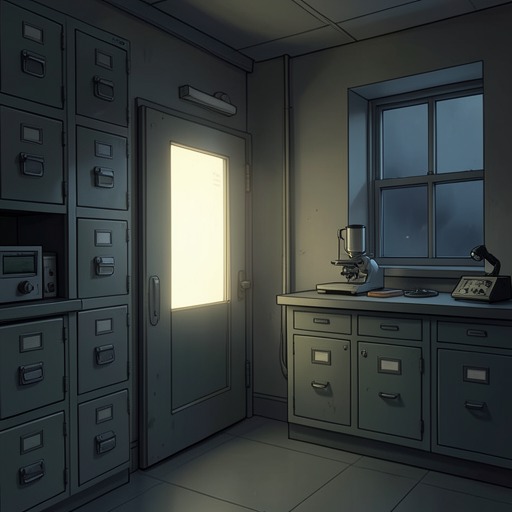
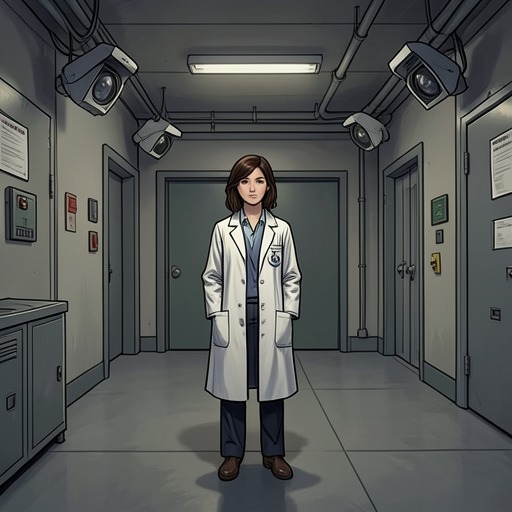
The laboratory occupies a thermally insulated, roughly cube-shaped cinder-block room in the farthest corner of SMSC Pod Five. To reach it, Katherine must cross a large, unlit specimen bay: when Peter Solomon first brought her there, he described the distance as enough to fit a football field. The pod was not wired for electricity, but a hydrogen fuel cell supplied power. Its sealed, photo-resistant exterior and the laboratory’s radio-frequency separation were intended to protect the space from radiation and other interference.
That separation was essential to Katherine’s work. She believed nearby human activity could introduce effects as subtle as brain radiation or thought emissions, making an ordinary university or hospital laboratory unsuitable. The remote, sealed pod offered a way to conduct experiments without that surrounding noise. Its isolation is therefore practical as well as atmospheric: the darkness marks the boundary between the outside world and the conditions her research requires.
The approach to the laboratory was an experience Katherine had to learn rather than simply navigate. Three years before the main events, Peter entered the darkness ahead of her and told her to trust him. The heavy door shut behind her, leaving her unable to see even her hand; she lost her bearings within seconds. She eventually found her way through a simple guidance system that Peter had allowed her to discover for herself. By the time she returned to the Cube years later, the once-frightening passage had become part of her daily routine. The crossing took about ninety seconds, though it continued to make her feel relieved when she reached the laboratory’s clean, illuminated entry room.
Interior and Research Equipment
Inside, the Cube is a massive windowless enclosure. Stiff mesh made of titanium-coated lead fiber covers its walls and ceiling, creating the impression of a cage within the surrounding cement structure. Frosted Plexiglas partitions divide the interior into a laboratory, control room, mechanical room, bathroom, and small research library. The arrangement combines the protection of a sealed facility with the distinct working areas required for Katherine’s research.
The main laboratory contains paired electroencephalographs, a femtosecond comb, a magneto-optical trap, and quantum-indeterminate electronic noise devices known as Random Event Generators. The contrast between these advanced instruments and the seemingly mystical questions they address is central to the lab’s identity. In the novel’s account of Noetic Science, controlled experiments at institutions including the Institute of Noetic Sciences and the Princeton Engineering Anomalies Research Lab are presented as evidence that focused human thought can affect physical mass, potentially down to the subatomic level. The Cube gives Katherine a specialized place to pursue that question, rather than treating it as a parlor trick or an abstract speculation.
One episode in the field’s history gives her research a larger scale. In the hours after the September 11 attacks, four scientists observed that thirty-seven Random Event Generators around the world had become significantly less random. The account links the change to people focusing together in grief, interpreting the machines’ more ordered outputs as a possible physical correlate of shared human attention. Studies of mass meditation and prayer are also described as producing similar results. Katherine’s interest in this possibility informs her global, web-based study, which investigates whether human intention can affect the world.
Katherine’s Use of the Cube
The laboratory is not merely a workplace but a protected home for research that Katherine and Peter have agreed to keep secret until its implications are better understood. Katherine believes that her experiments, especially those of the preceding six months, have yielded results capable of changing established ways of thinking. She expects eventually to publish major scientific revelations, but for the time being the findings remain inside the secure pod.
That secrecy shapes the lab’s storage arrangements. Katherine regularly checks the hydrogen fuel cell and visits the temperature-controlled vault where two synchronized holographic storage units hold identical copies of her work. Although standard backup practice might place an additional copy off-site to guard against fire, theft, or earthquake, she and Peter have chosen not to send the data beyond the building. They consider confidentiality more important than the protection an external server might provide, since they could not be certain the research would remain private once it left the facility.
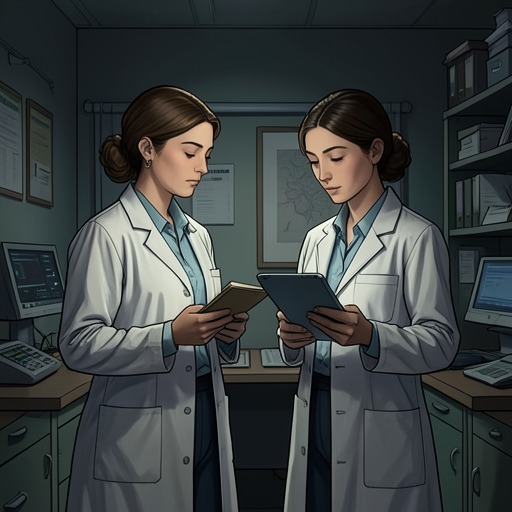
Trish Dunne, Katherine’s metasystems analyst, is the only other person permitted into the laboratory. A gifted data modeler, she works with Katherine in the control room, where a large plasma display supports the analysis. Her access is governed by a strict nondisclosure agreement, reflecting how closely the laboratory’s restricted membership and the handling of its data are bound together.
Breach and Destruction
Mal’akh learns from Katherine that her research is concentrated in one location, secured inside the laboratory. He regards the work as dangerous because, in his view, allowing its discoveries to emerge could change the world; he decides that it must be destroyed. His attack turns the Cube’s defining protections against it. A perimeter guard investigating an open Pod Five door is pulled into the darkness, and Mal’akh escapes after setting a trail of fuel oil across the floor toward the laboratory.
The guard recognizes the structure at the back of the bay as Katherine’s lab and understands that the burning trail may reach beneath its outer door. Before he can get help, air is drawn through the pod. The resulting hydrogen fireball tears off the roof and sends fragments of titanium mesh, electronic equipment, and melted material from the holographic storage units into the night. Katherine, driving away from the facility, sees the flash and then the fireball rising above the trees. She connects the blaze to the laboratory and to the intruder she has reported, while still trying to understand why he targeted her work.
The attack makes the Cube’s central contradiction plain: its isolation has protected a line of research from unwanted interference and observation, but concentrating the work in a single concealed site has also exposed it to a single destructive assault. The laboratory’s destruction is therefore more than damage to a room. It threatens Katherine’s research, the physical records of her findings, and the secret on which she and Peter had agreed to keep their work.